
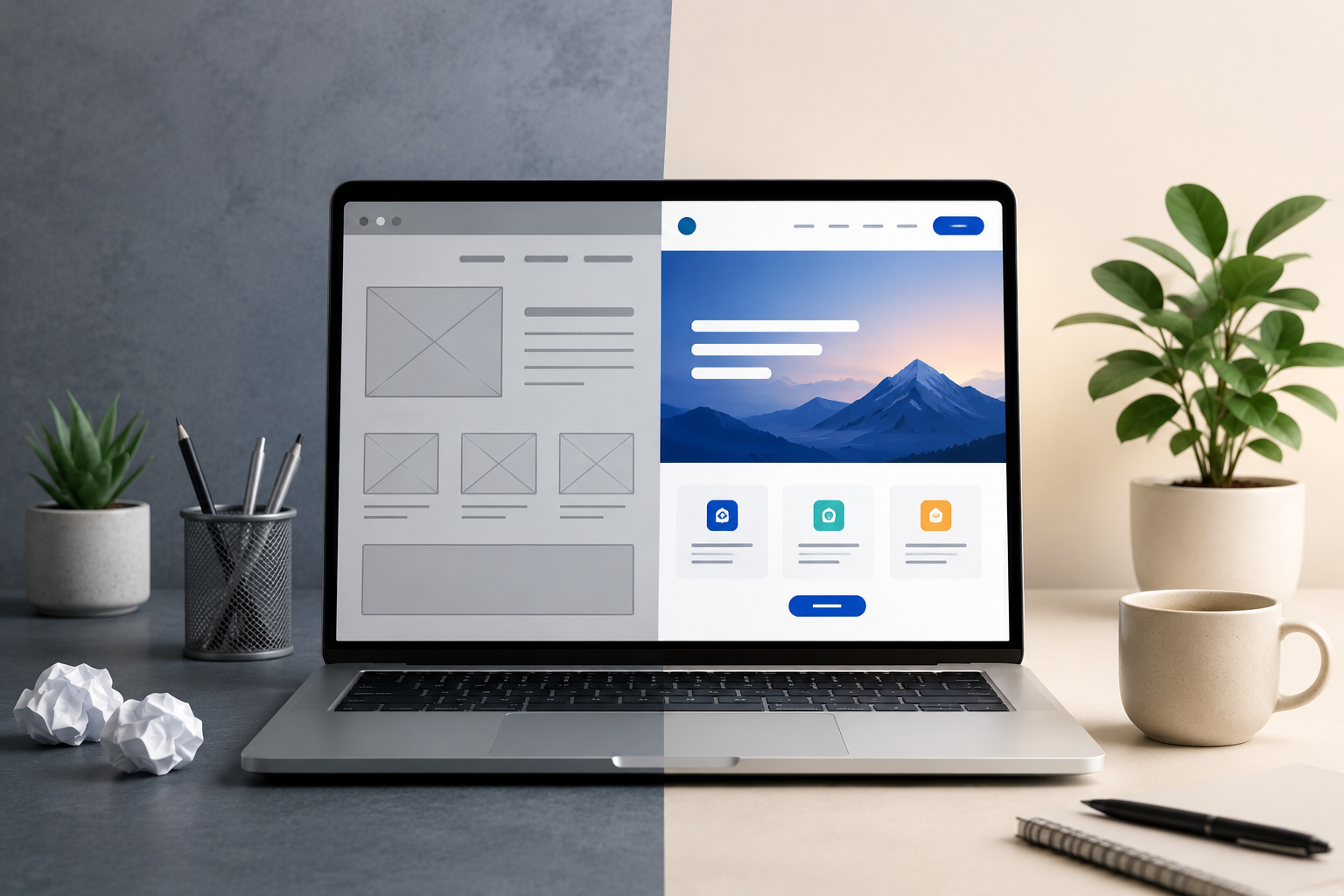
Your website may still be working, but that does not necessarily mean it is working well.
Perhaps customers struggle to find important information. Maybe the design looks dated compared with your competitors. Your website may load slowly, feel difficult to use on mobile devices, or simply no longer represent the business you have become.
This is where many businesses face an important decision: should you invest in a redesign or start from scratch with a completely new website?
The right answer depends on the condition of your existing website, the technology behind it, the quality of its content, and what you want the new website to achieve.
For some businesses, a carefully planned website redesign is the most practical option. For others, trying to rebuild an outdated website can create more problems than it solves.
What Is a Website Redesign?
A website redesign involves improving an existing website rather than completely replacing its foundation.
Depending on the situation, this could involve updating the visual design, improving navigation, restructuring pages, making the site more mobile friendly, improving performance, or changing how information is presented.
A redesign can be relatively focused or involve substantial changes across the entire website.
For example, a business may retain its existing website structure while updating the design and user experience. Another business may keep valuable content and search visibility while rebuilding much of the website around a better structure.
The important point is that a redesign does not automatically mean changing everything.
When Should a Business Consider a Website Redesign?
A website redesign usually makes sense when the existing website still has a useful foundation but no longer meets the needs of the business or its customers.
Your Website Looks Outdated
Design expectations change quickly. A website that looked modern several years ago may now appear old fashioned or difficult to navigate.
An outdated design can affect how visitors perceive the business before they even read the content.
A redesign can give the website a more current appearance while retaining useful assets from the existing site.
Your Business Has Changed
Businesses evolve.
You may have introduced new services, expanded into new markets, changed your positioning, or developed a different target audience.
If your website still communicates what your business used to be rather than what it is today, a redesign can help bring the digital experience in line with the current business.
The Website Is Difficult to Use on Mobile
A large proportion of website visitors now browse from smartphones.
If users have to zoom, scroll excessively, or struggle with menus and forms on a mobile device, the website is creating unnecessary friction.
A redesign can focus on responsive layouts, simpler navigation and a more comfortable mobile experience.
Your Existing Website Has Valuable SEO Equity
This is an important consideration that businesses sometimes overlook.
An established website may already have indexed pages, useful content, backlinks and search visibility.
Replacing the entire website without a proper migration strategy can put some of that visibility at risk.
If the existing website has a solid foundation, a redesign may allow the business to improve the experience while carefully preserving valuable search assets.
When Is a New Website the Better Choice?
Sometimes a redesign is not enough.
If the underlying website technology is outdated, poorly maintained or difficult to work with, rebuilding the website may be more efficient.
The Existing Technology Is Holding You Back
A website can reach a point where making changes becomes unnecessarily complicated.
Perhaps adding a new feature requires extensive development work. Maybe the content management system no longer suits your business. Or the website depends on outdated technology that makes maintenance difficult.
In such cases, starting with a new website can provide a cleaner and more flexible foundation.
The Website Has Serious Structural Problems
If the website has inconsistent page structures, confusing navigation, technical problems and years of accumulated changes, redesigning individual elements may not solve the underlying issues.
A new website gives the business an opportunity to rethink the architecture from the beginning.
Your Business Model Has Completely Changed
A company that once needed a simple informational business website may now need an entirely different digital platform.
For example, the website may need to support significantly different services, audiences, content structures or customer journeys.
When the purpose of the website has fundamentally changed, building a new website may make more sense than modifying the old one.
Website Redesign vs New Website: How Should You Decide?
The easiest way to approach the decision is to separate the visible problems from the underlying problems.
If the main issues involve appearance, navigation, content presentation and user experience, a redesign could be appropriate.
If the problems involve the technology, architecture, scalability or fundamental purpose of the website, a new website may be the better investment.
A useful question to ask is:
Is the existing website worth improving, or would rebuilding it create a stronger foundation for the next few years?
That question is often more useful than simply comparing the immediate cost of redesigning versus rebuilding.
What Affects Website Redesign Cost?
There is no universal website redesign cost because every project has a different starting point.
The final investment can depend on the number of pages, design requirements, content changes, technical complexity, integrations, functionality and development requirements.
A small business website with a limited number of pages may require relatively straightforward improvements.
A larger business website with extensive content, multiple services, complex navigation and third party integrations can require significantly more planning and development.
The cost should therefore be evaluated against the business objective rather than simply the number of design changes.
A cheaper redesign that leaves fundamental problems unresolved may not provide much value. A properly planned project can cost more initially but create a website that is easier to manage and more effective for customers.
What Should You Preserve During a Redesign?
A redesign should not be treated as an opportunity to discard everything that already exists.
Before making major changes, businesses should identify which pages, content and website elements are already performing well.
Important pages should be reviewed before they are removed or significantly changed.
Existing search visibility should also be considered during the transition. Changes to page structures and URLs need to be planned carefully so that the redesigned website does not unnecessarily lose valuable organic visibility.
This is one reason a website redesign should involve more than just a designer.
The design, content, development and search strategy need to work together.
Common Website Redesign Mistakes
One of the biggest mistakes is redesigning a website purely for visual reasons.
A website can look beautiful and still provide a poor user experience.
Another common mistake is changing URLs without considering their existing value. Businesses may also remove useful pages simply because they look old, without checking whether those pages attract visitors or support the site’s search presence.
Ignoring mobile users is another costly mistake.
The redesigned website should be tested across different screen sizes, browsers and devices before launch.
Most importantly, businesses should define what success looks like before development begins.
Is the objective more enquiries? Better navigation? Stronger visibility? A clearer presentation of services? Better performance?
The answer should influence the redesign decisions.
Making the Right Investment for Your Business
There is no universal winner between a website redesign and a new website.
A redesign is often suitable when the existing website has valuable foundations but needs a better design, experience or structure.
A new website is generally more appropriate when the technology, architecture or purpose of the existing website has become a significant limitation.
For businesses evaluating website redesign India options, the decision should therefore begin with an assessment of the existing website rather than an immediate decision to rebuild everything.
Look at what is working, identify what is holding the business back and determine what the website needs to achieve next.
The right approach is not necessarily the one that changes the most. It is the one that creates the strongest website for the business and its customers.