
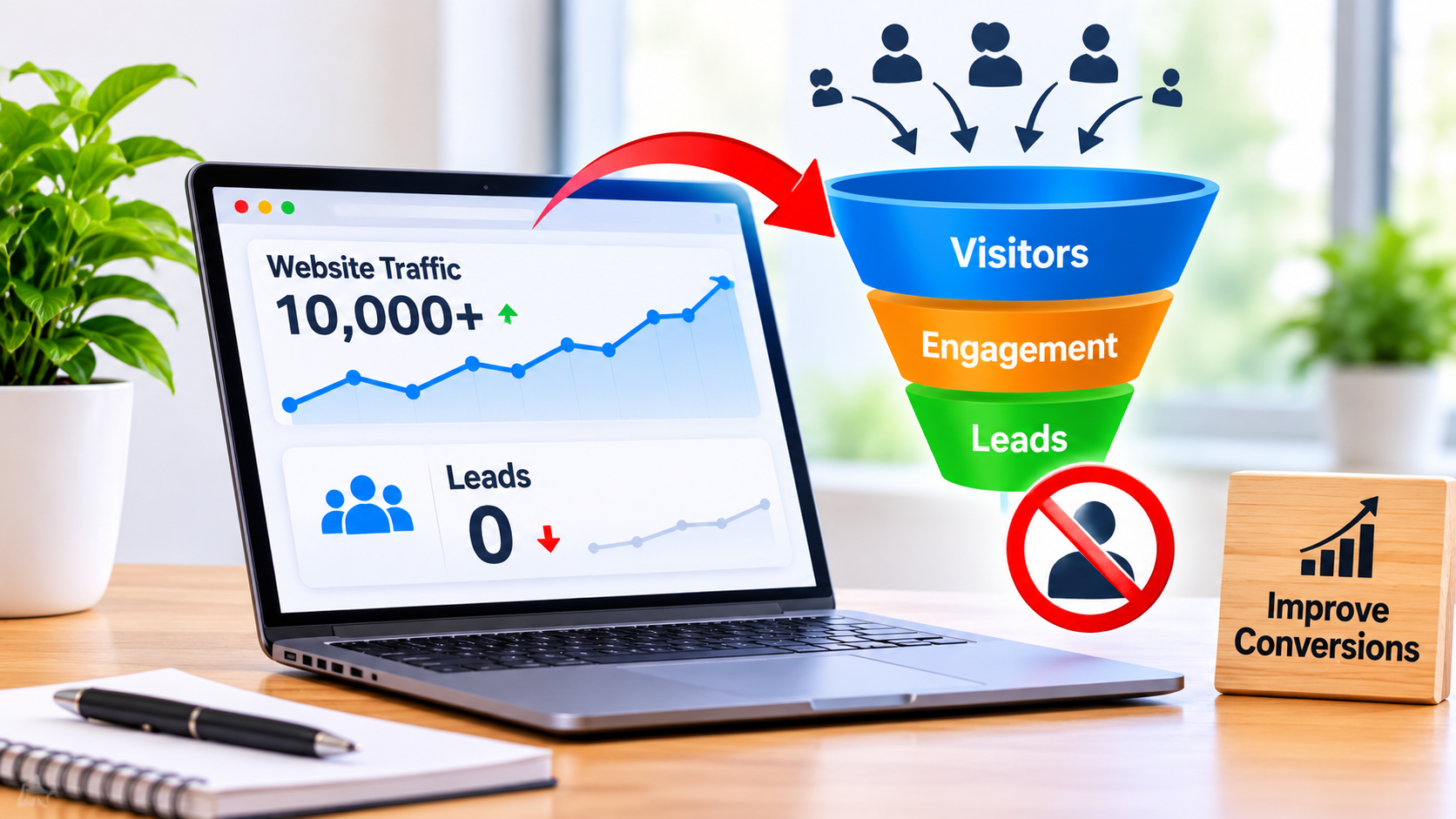
Getting visitors to your business website is an important achievement, but what happens after they arrive matters even more. You may be receiving consistent traffic through Google searches, social media, or paid campaigns, yet enquiries, calls, and form submissions remain low.
This is a common challenge for businesses investing in digital marketing. The problem is not always a lack of visitors. Sometimes, the website itself fails to convince people to take the next step.
A successful business website should do more than attract attention. It should build trust, communicate value, answer customer questions, and make it easy for visitors to enquire.
Let’s explore why your website might be getting traffic without generating leads and what you can do to improve its performance.
- Your Website Does Not Communicate Your Value Clearly
When visitors land on your website, they should immediately understand what your business offers and how it can help them.
If your homepage contains vague headlines, complicated descriptions, or too much technical information, visitors may struggle to understand your services.
For example, instead of using a generic headline such as “Welcome to Our Website”, use a clear statement explaining your service and its benefits.
How to improve it:
- Write clear and benefit-focused headlines.
- Explain your services using simple language.
- Highlight what makes your business different.
- Add relevant information above the fold.
A clear message helps visitors understand why they should choose your business.
- Poor Website User Experience Drives Visitors Away
Website user experience plays an important role in converting visitors into leads. If your website is difficult to navigate, loads slowly, or has confusing layouts, visitors may leave without exploring your services.
Common user experience problems include:
- Complicated navigation menus.
- Slow-loading pages.
- Broken links and buttons.
- Poor mobile responsiveness.
- Cluttered page layouts.
How to improve it:
Create a simple navigation structure, optimise images, improve loading speed, and ensure your website works smoothly across smartphones, tablets, and desktops.
A smooth browsing experience allows potential customers to find information without unnecessary effort.
- Your Website Lacks Strong Calls-to-Action
A visitor may be interested in your services but still leave because they do not know what to do next.
This is where calls-to-action (CTAs) become important.
A CTA is a message or button that encourages visitors to complete a specific action, such as booking a consultation, requesting a quote, or contacting your business.
Examples include:
- Get a Free Consultation
- Request a Quote
- Contact Our Team
- Book an Appointment
How to improve it:
Place relevant CTAs throughout your website, especially on service pages, landing pages, and the homepage. Make sure buttons are visible and lead visitors to the correct destination.
- Your Website Does Not Build Enough Trust
Before contacting a business, potential customers want to know whether they can trust its products or services.
If your website lacks credibility, visitors may hesitate to share their contact details.
Important trust-building elements include:
- Customer testimonials and reviews.
- Case studies and project examples.
- Business contact information.
- Professional team profiles.
- Relevant certifications and achievements.
Displaying genuine customer experiences and transparent business information helps visitors feel more confident about making an enquiry.
- You Are Attracting the Wrong Website Traffic
Not all website traffic has the same value. Your website might receive thousands of visitors, but if they are not interested in your services, they are unlikely to become customers.
For example, a business selling professional IT services may attract visitors searching for free coding tutorials. Although these visitors increase traffic, they may not be interested in purchasing the services.
How to improve it:
Focus on relevant search terms that match your services and customer requirements. Create useful content that addresses the questions your potential customers ask before making a purchase decision.
Understanding search intent helps attract visitors who are more likely to enquire.
- Your Contact Forms Are Too Complicated
Contact forms are often the final step between website visitors and potential leads. However, lengthy forms can discourage users from completing them.
Asking for unnecessary information creates additional effort and may cause visitors to abandon the process.
How to improve it:
- Keep forms short and simple.
- Request only essential information.
- Use clear field labels.
- Make forms mobile-friendly.
- Display a confirmation message after submission.
A simple enquiry process makes it easier for interested visitors to connect with your business.
- You Are Not Tracking Website Conversions
Without proper tracking, it becomes difficult to understand why your website is not generating leads.
Website traffic alone does not provide a complete picture of performance. You also need to understand what visitors do after arriving on your website.
Monitor important metrics such as:
- Conversion rate.
- Contact form submissions.
- CTA button clicks.
- Landing page performance.
- Traffic sources.
- Bounce and engagement rates.
Tools such as Google Analytics can help businesses understand visitor behaviour and identify pages that need improvement.
How to Turn Website Traffic into Quality Leads
Generating leads requires a combination of good design, relevant content, and a clear conversion strategy.
Start by reviewing your website from a customer’s perspective. Check whether your services are easy to understand, your contact information is accessible, and your CTAs encourage action.
Regularly test different headlines, page layouts, forms, and button placements. Even small improvements can make the website experience more effective.
Remember, the objective is not simply to increase website visitors. It is to attract the right audience and guide them towards meaningful business interactions.
Conclusion
Getting website traffic without generating leads can indicate that something is missing from your website’s conversion journey. Whether it is unclear messaging, poor navigation, weak CTAs, or irrelevant traffic, identifying these problems is the first step towards improvement.
A well-optimised website should attract the right audience, establish trust, and make taking action effortless.
Investing in website optimisation and a thoughtful digital strategy can help your business turn existing traffic into valuable enquiries and long-term customer relationships.
Frequently Asked Questions (FAQs)
- Why is my website getting traffic but no enquiries?
Your website may have unclear messaging, weak calls-to-action, poor user experience, complicated contact forms, or traffic that does not match your target audience.
- How can I convert website visitors into leads?
Improve your website content, add visible CTAs, simplify enquiry forms, display customer testimonials, and ensure your website provides a smooth browsing experience.
- Does website design affect lead generation?
Yes. Website design influences navigation, readability, credibility, and user experience, all of which can affect whether visitors decide to contact your business.
- How important is website loading speed for conversions?
Loading speed is important because slow websites can frustrate visitors and interrupt their browsing experience, potentially reducing enquiries.
- How do I measure website lead generation performance?
Track contact form submissions, phone enquiries, CTA clicks, conversion rates, and landing page performance using website analytics tools.
